In the formal dining rooms of Dubai, Abu Dhabi, and Sharjah, a single piece of furniture absorbs more social scrutiny than any other object in the home. The dining table is where a family demonstrates its standing to guests, where the ritual of communal eating prescribed by Gulf hospitality tradition physically takes place, and where interior design decisions face their most public test. Studios like Solomia Home in Dubai specify and deliver complete dining compositions built around brands such as Cattelan Italia and Bonaldo, treating the table as the architectural anchor of the room rather than as a furnishing afterthought.
The Social Architecture of the Dining Room in the Gulf
The UNESCO-inscribed Majlis tradition, recognized on the Representative List of the Intangible Cultural Heritage of Humanity since 2015, provides the cultural framework that still governs spatial hierarchy in Emirati and Arab Gulf households. While the Majlis itself is the reception room for guests, coffee, and conversation, the formal dining room operates as its direct extension: the space where generosity is made tangible through food. In this cultural context, the dining table is not a background element. It is the single most observed piece of furniture in the home. Guests evaluate its material, its scale, the way it relates to the room’s proportions, and the quality of the chairs surrounding it. What registers is not expense but coherence. A marble slab placed on undersized legs, or a glass top that crowds the room, communicates carelessness in a cultural environment where hosting carries ethical weight.
The UAE luxury furniture market, valued at approximately USD 0.72 billion in 2025 and projected to reach USD 1.03 billion by 2030 at a 7.51% CAGR according to Statista’s UAE Furniture Market Forecast, reflects the scale of investment flowing into residential interiors. Dubai alone commands over 56% of that market. Within this spending, the dining room receives disproportionate attention relative to its square footage because it is the most socially exposed room after the Majlis itself. A dining table specified for a villa in Emirates Hills or Jumeirah Golf Estates carries expectations that differ structurally from those in a European household. The gatherings are larger, the meals are longer, the table must accommodate 10 to 14 guests as standard rather than the 6-seat default of most Western production catalogs.
Cattelan Italia: Glass-and-Steel Engineering from Veneto

Cattelan Italia, founded in 1979 by Giorgio and Silvia Cattelan in Carre, Vicenza (VI), Italy, manufactures entirely within the Veneto region and distributes to over 104 countries. The company’s dining table program is centered on a specific material proposition: tempered and laminated glass tops paired with engineered steel leg systems that achieve structural integrity at minimal visual weight. Their production facility handles kiln-fused glass processing in-house, allowing dimensional control from raw sheet to finished top.
The Skorpio Collection: Technical Specifications
The Skorpio, designed by Andrea Lucatello and first released in 2014, has become Cattelan Italia’s most recognized dining table. Its base is produced in laser-cut steel, available in titanium (GFM11), bronze (GFM18), graphite (GFM69), pearl (GFM70), or black (GFM73) embossed lacquered steel, as well as hand-finished Brushed Bronze or Brushed Grey lacquered steel variants. The top specification separates the Skorpio from production glass tables: 15mm tempered clear, extra clear, extra clear bevelled, or extra clear textured (MIST) glass across most sizes. The smaller configurations at 160 x 90 cm, 182 x 90 cm, and 200 x 106 cm use 12mm tempered glass as the reduced span permits a thinner section without compromising load performance.
The top is not bonded to the frame; it is laid on the base, which means the glass can be replaced independently of the steel structure. The Skorpio is available in 8 rectangular, 3 oblong, and 2 square configurations. The 300 cm (118″) length seats 10 to 12 people, placing it within the range required for Gulf formal dining. The reversed bevelled edge option is restricted to two rectangular sizes: 240 x 120 cm and 300 x 120 cm, available only in extra clear glass. Retail pricing begins at approximately $3,400 for the 160 cm rectangular configuration and extends past $14,000 for the 300 cm Senator and larger Keramik variants.
| Size (cm) | Glass Thickness | Seating Capacity | Edge Options |
|---|---|---|---|
| 160 x 90 | 12mm tempered | 4-6 | Standard, extra clear |
| 182 x 90 | 12mm tempered | 6 | Standard, extra clear |
| 200 x 106 | 12mm tempered | 6-8 | Standard, extra clear, MIST |
| 240 x 120 | 15mm tempered | 8-10 | Standard, extra clear, reversed bevel |
| 300 x 120 | 15mm tempered | 10-12 | Standard, extra clear, reversed bevel |
The Skorpio Family Expansion
Since 2014, the Skorpio has expanded to nine distinct variants: the original glass model, Skorpio Wood (Canaletto walnut or burned oak top), Skorpio Keramik (ceramic top in over 16 finishes including Sahara Noir, Portoro, Golden Calacatta, Makalu, and Luxor), Skorpio Keramik Premium (hand-brushed thick ceramic edge), Skorpio Ker-Wood Round (wood top with ceramic insert), Skorpio CrystalArt (printed glass top), and the Round versions of each. The Keramik range offers tops in ceramic finishes coded from KM02 (Alabastro) through KS23 (Luxor), with both matte and glossy options for stones like Calacatta and Portoro. For Dubai dining rooms where the 300 cm glass top feels structurally aggressive, the Keramik variant provides the same visual footprint with a ceramic surface that handles heavy daily use with less maintenance concern than glass.
Bonaldo: Material Vocabulary and Proportional Range
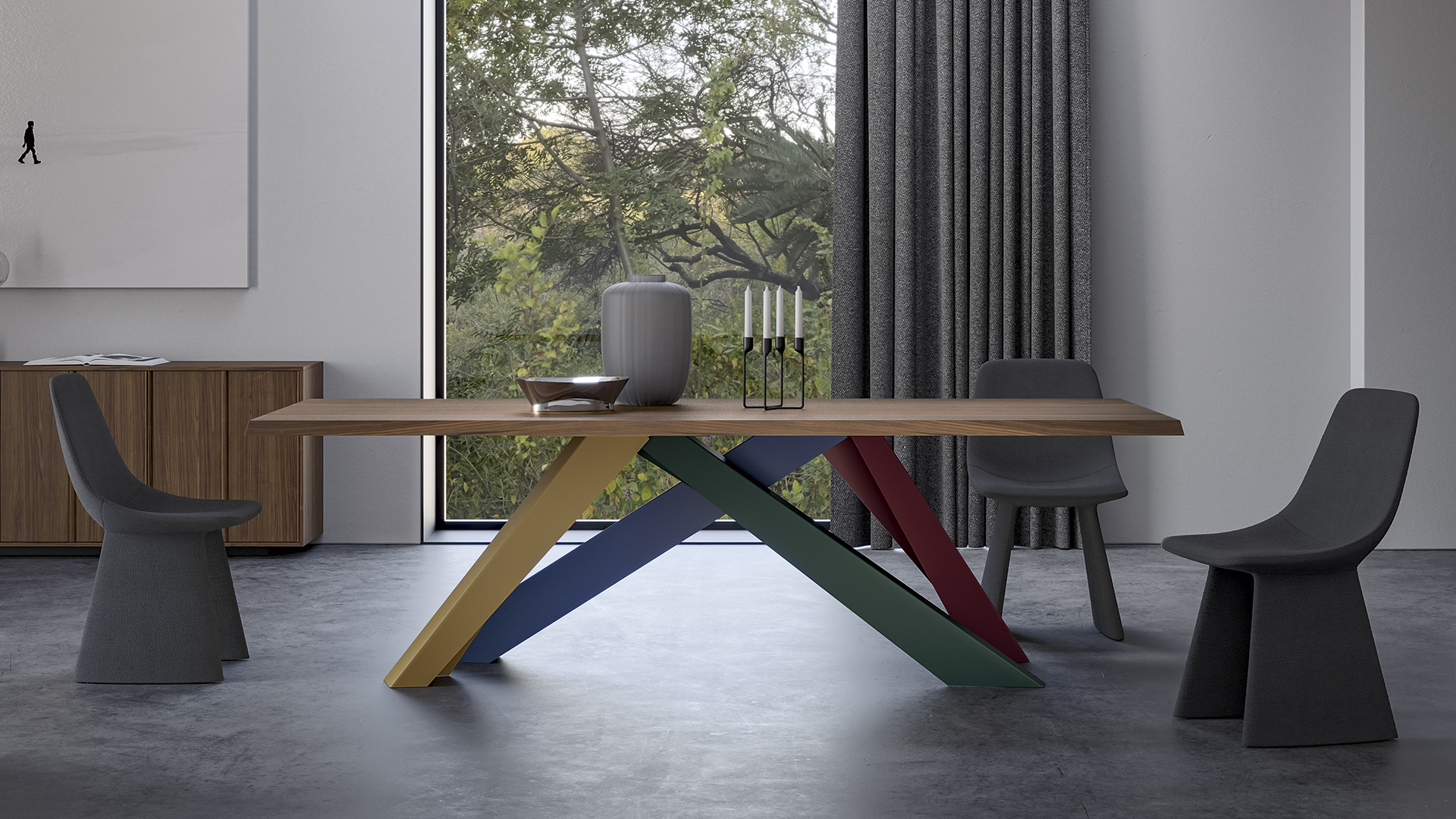
Bonaldo, founded in 1936 in Villanova di Camposampiero, Padova, Italy, approaches the dining table from a different material position than Cattelan. Where Cattelan prioritizes visual lightness through glass, Bonaldo builds its dining program around solid wood, ceramic, marble, and hand-spatulated clay, producing tables that convey physical mass and permanence. This distinction matters in Gulf dining rooms where the table must read as substantial across a large floor plate.
The Big Table: Bonaldo’s Icon
The Big Table, designed by Alain Gilles (named Designer of the Year at the 2012 Interieur Kortrijk Fair; his Welded table for Bonaldo received the Red Dot: Best of the Best recognition in 2013), uses laser-cut steel legs painted in multi-color geometric combinations. The leg inclination produces a sense of dynamic tension against the horizontal plane of the top. Available in fixed and extending versions, the Big Table reaches 300 cm x 120 cm x 76 cm (h) in the largest fixed configuration with a solid wood top, and 300 cm x 108 cm x 74 cm (h) in ceramic variants. A Special Edition in Saint Denis marble was produced in 2019 to mark the design’s 10th anniversary.
| Width (cm) | Depth (cm) | Height (cm) | Available Top Materials |
|---|---|---|---|
| 160 | 90 | 74 | Veneered wood, lacquered wood, ceramic |
| 180 | 90 | 74 | Veneered wood, lacquered wood, ceramic |
| 200 | 100 | 74 | Solid wood, veneered, ceramic, marble |
| 220 | 100 | 74 | Solid wood, veneered, ceramic, marble |
| 250 | 100-110 | 74 | Solid wood (natural edge at 110cm), ceramic |
| 300 | 108-120 | 74-76 | Solid wood (120cm), ceramic (108cm), marble |
Leg color combinations include bordeaux / racing green / brass yellow / royal blue, coral red / orange / green / lilac, powder pink / brown / taupe / amaranth, and mono-finish options in anthracite grey, white, Corten brown, bronze-copper, or burnished. The multi-color leg option is distinctive to Bonaldo and serves Dubai clients who want the table to carry a level of visual complexity that a monochrome base does not provide.
The AX Table: Extension Engineering
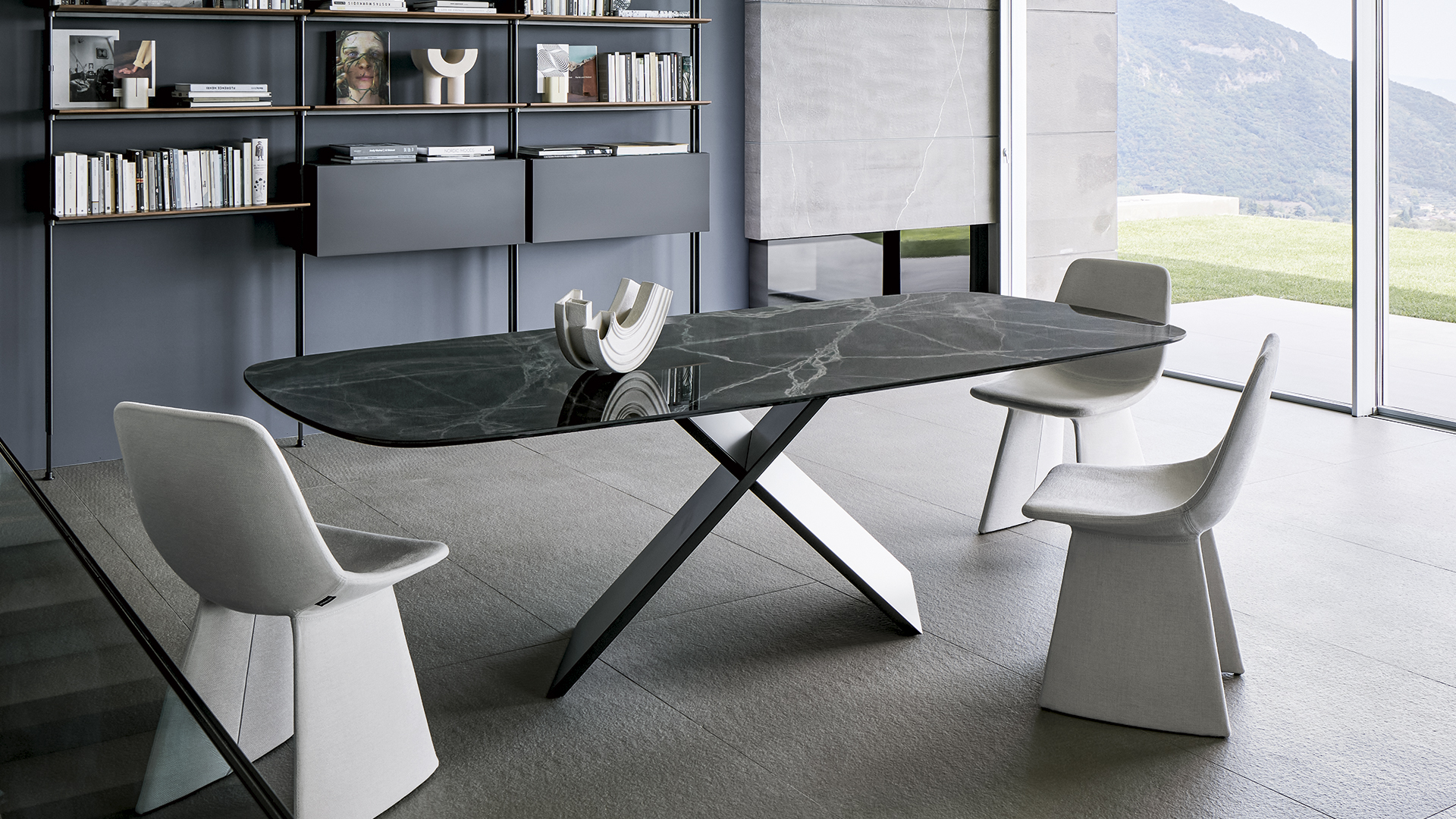
The AX, designed by Gino Carollo, addresses extension mechanism engineering directly. Its crossed-base geometry in painted aluminium provides structural bracing during both open and closed states. The fixed version spans 200 x 100 x 75 cm through 300 x 120 x 75 cm (American Walnut only at 300 cm width). Top materials include wood, ceramic in finishes such as Calacatta, Ceppo di Gre, Emperador, White Statuary, and Tafu, and transparent glass. The extending mechanism permits a single table to move from an 8-seat weekday configuration to a 12-seat formal layout without a second table being stored elsewhere in the residence.
The Dorian and Louver Tables: Sculptural Alternatives
Bonaldo’s Dorian, designed by Bartoli Design, uses an elongated cylindrical base inspired by Greek column forms. Available in five sizes from 200 x 108 cm through 300 x 120 cm, all at 75 cm height, the Dorian’s oval top in ceramic, marble, or wood addresses a specific spatial condition in Gulf villas: rooms wide enough to accommodate a non-rectangular plan that improves sight lines across a large gathering. The Louver Table, designed by Alain Gilles, takes this further with a three-legged marble base available up to 280 x 114 x 76 cm, weighing up to 332 kg in the largest configuration.
Specifying for Dubai: Dining Room Dimensions and Table Selection
Dubai villa dining rooms in developments such as Emirates Hills, Dubai Hills Estate, and Palm Jumeirah typically measure between 4.5 x 5.5 m and 6.0 x 7.0 m. Apartment dining areas in towers along Sheikh Zayed Road and Dubai Marina are more constrained, commonly 3.5 x 4.5 m in 2-bedroom units and 4.0 x 5.5 m in 3-bedroom configurations. These dimensions dictate the functional boundary of table selection.
| Room Width | Recommended Table Length | Clearance per Side (to wall) | Practical Seating |
|---|---|---|---|
| 3.5 m | 180-200 cm | 65-85 cm | 6 |
| 4.0 m | 200-240 cm | 80-100 cm | 6-8 |
| 4.5 m | 240-250 cm | 100-130 cm | 8-10 |
| 5.5 m+ | 280-300 cm | 100-135 cm | 10-14 |
The critical clearance measurement is the distance between the edge of the table and the nearest wall or piece of furniture. A minimum of 80 cm is required for chair pullback and circulation behind seated guests. In rooms where service from a sideboard is expected, 100 cm or more on the service side is standard practice. This is why the 2.4 m table works in most Dubai apartments while the 3.0 m table requires a dedicated room with a minimum width of 5 m to maintain comfortable circulation on both long sides.
Chair Specification as a Compositional Decision
The chair surrounding a Gulf dining table is not a secondary purchase. It functions as part of the table’s visual mass, and its seat height, arm width, and back profile determine whether the overall composition reads as generous or cramped. Cattelan Italia’s dining chairs typically use a 46-48 cm seat height against their 74-75 cm table height, producing a standard 27-28 cm differential that accommodates formal dining posture. Bonaldo’s chair program, including models designed by Bartoli Design and Gino Carollo, follows the same dimensional standard.
For tables at 300 cm length, specifying identical chairs for all 12 positions creates visual monotony across the span. A common approach in Gulf dining rooms is to use host chairs with arms at the table ends and armless side chairs along the flanks. The arm width of the host chair must clear the table leg or apron geometry. On the Cattelan Skorpio, the outward-angled steel legs create a clearance zone at the table corners that accommodates arm chairs with a width of up to 60 cm. On the Bonaldo Big Table, the inclined legs occupy more underframe space at the ends, making it necessary to verify arm-chair clearance against the specific size ordered.
Lead Times, Extension Mechanisms, and Surface Care
Standard production lead times from both Cattelan Italia and Bonaldo for UAE delivery run between 8 and 14 weeks from order confirmation, depending on finish selection and current factory scheduling. Custom dimensions or non-catalog finishes extend this to 16-20 weeks. Shipping from Northern Italy to Dubai via sea freight typically adds 4-6 weeks beyond factory completion.
Extension mechanisms in tables like the Bonaldo AX and the Cattelan Duffy Keramik Drive use synchronized rail systems with integrated leaf storage. The Duffy Keramik Drive extends via a telescoping aluminium rail that carries the ceramic extension leaf from a stored position beneath the main top. These mechanisms add 40-60 cm to the closed length per extension, with most two-leaf systems adding up to 100 cm total. The engineering challenge is rail rigidity under loaded ceramic: a fully set extension table with plates, glasses, and serving ware at 12 positions applies static and dynamic loads that cheap extension rails cannot sustain without deflection.
Surface Care in Heavy-Use Dining Contexts
- Tempered glass (Cattelan Italia): Clean with non-abrasive glass cleaner and microfiber cloth. Avoid acidic substances directly on the surface. Tempered glass resists thermal shock up to approximately 250 degrees C differential. Chips at edges are the primary failure mode; replacement of the laid-on top does not require disassembly of the steel base.
- Ceramic/Keramik tops (both brands): Resistant to scratching, UV fading, and thermal shock. Clean with pH-neutral detergent. The sintered surface does not absorb liquids. Surface hardness typically rated at Mohs 6-7.
- Marble (Bonaldo): Requires sealing upon delivery and re-sealing every 6-12 months in heavy-use environments. Acidic foods (lemon, vinegar, tomato) etch unsealed marble within minutes. The 14mm Calacatta marble top on the AX is thinner than architectural slab norms, making edge chip repair consequential.
- Solid wood (Bonaldo): Canaletto walnut and burned oak tops should be cleaned with a damp cloth and dried immediately. Avoid silicone-based polishes. Direct sunlight causes differential color shift over 12-24 months; UV-filtering window treatments are standard practice in south-facing Dubai rooms.
The Architectural Problem the Table Solves
The choice between a Cattelan Italia glass-topped Skorpio and a Bonaldo Big Table in solid walnut is not a choice between price points or brand prestige. It is a choice about what the dining room is asked to communicate. The glass table declares precision: the room is about light transmission, the visibility of the floor plane beneath the top, and the sculptural presence of the steel base. The wood or marble table declares substance: the room is about tactile material, weight, and the permanence of a surface that will age alongside the household. In Gulf dining culture, both propositions carry legitimate social meaning. The glass table signals confidence in modernity and maintenance. The wood table signals connection to material tradition and generational continuity.
What determines success in either case is the quality of specification. A 300 cm glass table in a 4-meter-wide room will dominate the space in a way that reads as error rather than intention. A 200 cm marble table in a 7-meter room will appear lost and under-scaled. The proportional relationship between table, room, chair count, and circulation clearance is the architectural problem that the dining room poses, and the table is the object through which that problem is either solved or exposed.